
This guide focuses specifically on tankless water heater decisions for homeowners in Paradise Valley, Chandler, and the greater Scottsdale area in 2025.
Tankless Water Heater Definition: A tankless (on-demand) water heater is a compact appliance that heats water directly through a gas burner or electric element as it flows through the unit, eliminating the need for a storage tank and the standby heat loss that comes with it.
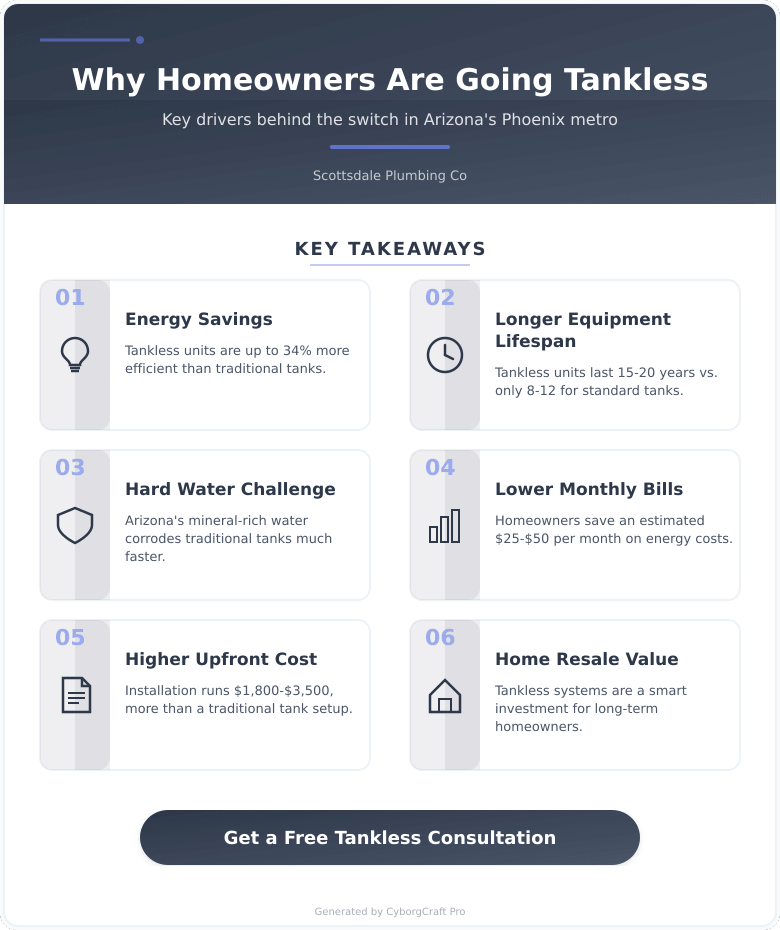
Over the past few years, the pattern has become hard to ignore. Homeowners in Chandler and Paradise Valley are calling plumbers not because something broke, but because they want to get ahead of the problem. Rising utility costs, tighter energy codes, and a growing awareness of how hard Arizona’s hard water is on traditional tanks have all pushed the conversation toward going tankless. According to the U.S. Department of Energy, tankless systems can be 24-34% more energy efficient than conventional storage-tank models for households that use 41 gallons or less of hot water per day.
Why Arizona’s Climate Makes Tankless Systems a Smart Fit
Arizona is not a typical case. The combination of intense summer heat, hard water with high mineral content, and year-round demand for hot water creates conditions where traditional 40-50 gallon tanks wear down faster than the national average. Sediment builds up quickly in Phoenix metro water, corroding tank liners and reducing heating efficiency within just a few years of installation.
Tankless units handle this differently. Because water is not sitting in a tank, mineral buildup is slower and more manageable with annual descaling. In a climate like ours, that extends the useful life of the equipment significantly. Most quality tankless units carry a 15-20 year lifespan compared to 8-12 years for conventional tanks.
Thinking about this for your situation? Let’s talk. We’ll walk you through your options – no pressure.
Tankless vs. Traditional Tank: Which Approach Works?
Where tankless succeeds: Lower operating costs over time, endless hot water for larger households, compact footprint, longer lifespan, and better performance in homes with fluctuating demand.
Where tankless falls short: Higher upfront installation cost, possible need for upgraded gas lines or electrical panels, and a slight delay in hot water reaching the tap if the unit is far from the fixture.
Where traditional tanks succeed: Lower purchase price, simpler installation in most homes, and no minimum flow rate required to activate the unit.
Where traditional tanks fall short: Standby heat loss (you pay to keep water hot even when you’re not using it), shorter lifespan in hard-water markets like the Phoenix metro, and limited capacity during back-to-back showers.
The verdict: For most Paradise Valley and Chandler homeowners planning to stay in their home for five or more years, tankless is the financially stronger choice when factoring in energy savings, lifespan, and resale value. Short-term or rental situations may favor the lower upfront cost of a traditional tank.
| Feature | Tankless Unit | Traditional Tank |
|---|---|---|
| Avg. Installation Cost (AZ, 2025) | $1,800 – $3,500 | Varies based on unit size and installation requirements |
| Lifespan | 15-20 years | 8-12 years |
| Energy Efficiency | Up to 34% more efficient | Baseline |
| Monthly Savings (est.) | $25 – $50/month | N/A |
| Best For | Long-term owners, larger households | Rentals, short-term, tight budgets |
Top Tankless Brands Worth Considering in 2025
| Brand | Model Line | Price Range (unit only) | Warranty | Best For |
|---|---|---|---|---|
| Rinnai | RU Series | $900 – $1,400 | 12-year heat exchanger | High-demand households |
| Navien | NPE-A2 Series | $1,000 – $1,500 | 15-year heat exchanger | Efficiency-focused buyers |
| Rheem | RTGH Series | $700 – $1,100 | 12-year heat exchanger | Value and availability |
| Noritz | EZ Series | $750 – $1,200 | 12-year heat exchanger | Easy retrofit installations |
| Bosch | Greentherm Series | $600 – $950 | 10-year heat exchanger | Smaller households, budget-conscious |
Arizona Tax Credits and Rebates You Should Know About (2025)
The federal Residential Clean Energy Credit and the Energy Efficient Home Improvement Credit (25C) remain active in 2025. Qualifying natural gas tankless water heaters may be eligible for federal tax credits based on their Uniform Energy Factor (UEF) rating. Certain electric heat pump water heaters may also qualify for federal incentives under the same program.
State-level incentives for water heater upgrades may vary, and some local utilities may offer rebates for high-efficiency appliance installations. Check with your utility provider directly, as rebate amounts and eligibility change throughout the year. According to the U.S. Department of Energy’s efficiency programs, Arizona residents may also qualify for additional weatherization assistance depending on household income.
Your Tankless Installation Action Plan
- Assess your current setup: Identify your existing fuel type (gas or electric), current unit size, and location. This determines what upgrades, if any, are needed for your gas line or electrical panel.
- Choose the right flow rate: Calculate your peak GPM (gallons per minute) demand based on the number of fixtures your household runs simultaneously. A licensed plumber can help you size the unit correctly for your specific needs.
- Pull the proper permit: Arizona requires a plumbing permit for water heater replacements. Your licensed plumber handles this, but confirm it before work begins.
- Schedule the installation: Installation time varies depending on the complexity of the job. Gas line upgrades or panel work add time, though most homeowners have hot water restored the same day.
- Plan for annual maintenance: Schedule a descaling flush every 12 months given Chandler and Paradise Valley’s hard water conditions.
- Confirm your plumber holds an Arizona ROC (Registrar of Contractors) license
- Verify the unit’s UEF rating before purchasing to confirm rebate eligibility
- Ask for a written warranty on both the unit and the labor
- Request the permit documentation after installation is complete
See how our approach compares – visit our services page or contact us for a free estimate.
Common Mistakes That Cost Homeowners Money
The most common mistake we see is undersizing the unit. A unit with insufficient flow rate in a five-bedroom Paradise Valley home with multiple bathrooms will leave someone with a cold shower every time. Always size up slightly if you’re between flow rate tiers.
- Skipping the permit (creates problems at resale and voids some manufacturer warranties)
- Ignoring hard water treatment (mineral buildup cuts efficiency and shortens lifespan)
- Choosing based on unit price alone without factoring in installation complexity
- Not asking about venting requirements for indoor gas units
Key Takeaways for Chandler and Paradise Valley Homeowners in 2025
- Energy savings are real – up to 34% more efficient than traditional tanks for average households
- Arizona’s hard water accelerates tank failure – going tankless reduces that risk
- Federal tax credits may be available for qualifying gas units in 2025 – consult a tax professional for details
- Proper sizing matters more than brand – match GPM to your household’s peak demand
- Annual descaling is non-negotiable in the Phoenix metro’s hard water environment
Frequently Asked Questions
How much does tankless water heater installation cost in Chandler or Paradise Valley?
Total installed cost in the Phoenix metro typically runs $1,800 to $3,500 for a gas unit in 2025. Factors include unit capacity, gas line condition, venting requirements, and whether an electrical upgrade is needed. Electric units generally cost less to install but may require panel upgrades.
Do I need a permit to install a tankless water heater in Arizona?
Yes, Arizona requires a plumbing permit for water heater replacements, including tankless installations. A licensed Arizona ROC plumber pulls the permit on your behalf. Work done without a permit can cause issues during home inspections at resale.
How long does a tankless water heater installation take?
Installation time depends on the complexity of the job and your home’s existing setup. If your home needs gas line upgrades, new venting, or electrical panel work, additional time will be required. Most homeowners have hot water restored the same day.
What is the best tankless water heater brand for Arizona homes?
Rinnai and Navien consistently rank at the top for performance and warranty coverage in high-demand Arizona households. Rheem is a strong mid-range option with wide local parts availability, which matters if you ever need a repair.
Can I get a federal tax credit for a tankless water heater in 2025?
Qualifying gas tankless units may be eligible for federal tax credits through the 25C Energy Efficient Home Improvement Credit in 2025. Certain electric heat pump water heaters may also qualify for federal incentives. Consult a tax professional to confirm eligibility and current credit amounts for your specific situation.
How often does a tankless water heater need maintenance in Arizona?
Annual descaling is recommended for most Phoenix metro homes due to high mineral content in local water. A professional flush takes about an hour and prevents efficiency loss and premature failure.
Ready to Make the Switch?
Chandler and Paradise Valley homeowners who make the move to tankless in 2025 are doing it for straightforward reasons: lower bills, fewer repairs, and equipment that actually keeps up with a busy household. The federal tax credits available this year add another layer of financial sense to an already solid long-term investment.
Scottsdale Plumbing Co serves homeowners throughout the Scottsdale area, including Paradise Valley, Chandler, Tempe, Mesa, Gilbert, and surrounding communities. Ready to take the next step? Contact us today for straight answers and a free estimate – no obligation, no runaround.

Write a comment: