
A leaky faucet cost is the cumulative financial drain created when a dripping fixture wastes water continuously, adding measurable dollars to your utility bill every single month. In dry climates like the East Valley, where water rates are rising and conservation matters, the numbers add up faster than most people expect.
This guide focuses specifically on the real 12-month financial impact of a leaky faucet for homeowners in Mesa and Gilbert, Arizona – plus a clear action plan to stop the waste.
Leaky Faucet Definition: A leaky faucet is any fixture that releases water when fully closed, typically due to a worn washer, faulty O-ring, or corroded valve seat, resulting in continuous water loss measured in drips per minute.
The Leaky Faucet Cost Breakdown – What the Math Actually Says
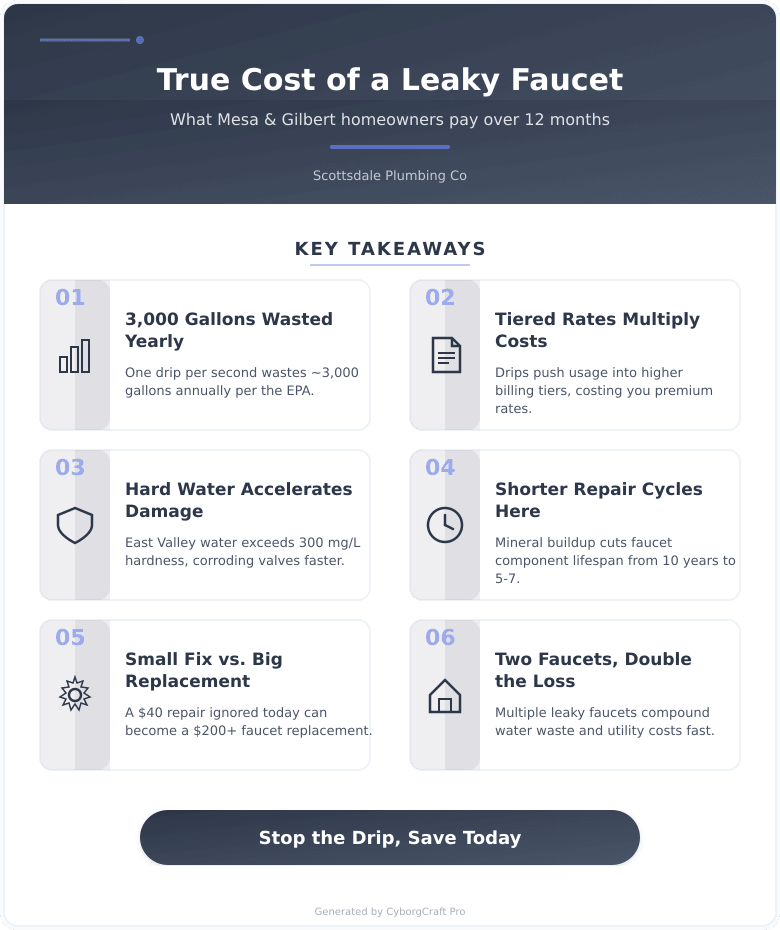
A faucet dripping once per second wastes roughly 3,000 gallons per year, according to the U.S. Environmental Protection Agency’s WaterSense program. That’s not a rounding error. That’s real water you’re paying for.
In Mesa and Gilbert, the Salt River Project and local municipal utilities price water at tiered rates. The more you use, the higher your rate climbs. A slow drip pushes households into higher billing tiers – meaning that faucet isn’t just wasting water, it’s actively costing you at a premium rate.
Here’s what the numbers look like over 12 months at common drip rates:
| Drip Rate | Gallons Wasted/Year | Estimated Annual Cost | Tier Impact |
|---|---|---|---|
| 1 drip/second | ~3,000 gal | Low to moderate added cost | Low to moderate |
| 2 drips/second | ~6,000 gal | Moderate added cost | Moderate |
| Slow stream | ~15,000+ gal | Significant added cost | High – pushes tier increase |
And if you have two leaky faucets – which is more common than people realize – you can double those figures. The most common mistake homeowners make is treating a drip as a nuisance rather than a bill-generating problem.
Want to get ahead of this before it costs you more? Contact us for a straightforward assessment – no pressure, just answers.
Why Mesa and Gilbert Homes Face a Harder Version of This Problem
Hard water is the silent accelerator here. The East Valley sits in one of the hardest water zones in the entire Southwest. Mineral deposits – primarily calcium and magnesium – build up inside faucet valves and cartridges faster than in most other regions of the country.
That mineral buildup corrodes internal components and prevents seals from closing completely. A faucet that was perfectly fine two years ago can develop a drip simply from routine exposure to local water. This isn’t a product quality issue. It’s a regional chemistry problem.
According to the EPA’s drinking water resources, hard water affects fixture longevity across the country, but Arizona’s water hardness levels rank among the highest nationally – often exceeding 300 mg/L in parts of Maricopa County.
The practical result: faucet components in Mesa and Gilbert wear out sooner. Washers crack. Cartridges fail. O-rings stiffen and shrink. What would be a 10-year repair cycle elsewhere becomes a 5-7 year cycle here.
Fixing It vs. Ignoring It: Which Approach Works?
Where fixing it immediately succeeds: Stops water waste at the source, eliminates tier-rate billing increases, protects internal valve components from further mineral damage, and costs far less than a full faucet replacement later.
Where fixing it immediately fails: If the underlying cartridge or valve body is already corroded beyond a simple repair, a patch fix may only delay the inevitable by a few months.
Where ignoring it succeeds: Honestly? It doesn’t. The only argument for waiting is short-term convenience, and even that doesn’t hold up once you see the 12-month cost numbers.
Where ignoring it fails: Water waste compounds daily. Mineral deposits worsen the internal damage. What starts as a $40 repair can become a $200+ faucet replacement. And if the leak worsens into a slow stream, you’re looking at serious tier-rate billing spikes on your Mesa or Gilbert utility statement.
The verdict: Fix it now. A standard faucet repair in the Phoenix metro area typically runs $140-$350 for a plumber visit in 2026. That’s often less than a single month of wasted water at a slow-stream drip rate, plus you stop the damage cycle immediately.
Thinking about this for your situation? Let’s talk. We’ll walk you through your options – no pressure. Reach out here and we’ll help you figure out what you’re actually dealing with.
Your Leaky Faucet Action Plan
- Step 1 – Confirm the drip rate: Place a cup under the faucet for 60 seconds and count the drips. This gives you a baseline to calculate your actual monthly waste.
- Step 2 – Check your water bill trend: Pull the last 3-4 utility statements and look for gradual increases that don’t match your usage habits. A creeping bill is a strong sign of ongoing water loss.
- Step 3 – Identify the faucet type: Ball faucets, cartridge faucets, and compression faucets each have different repair approaches. Knowing which type you have helps your plumber arrive prepared.
- Step 4 – Check for hard water damage: If you see white mineral crust around the base of the handle or aerator, the internal components may already need replacement rather than simple repair.
- Step 5 – Schedule a repair before the next billing cycle: Every billing cycle you wait adds real dollars to your statement. A repair scheduled this week stops the loss starting today.
- Drip repairs on standard faucets typically take 30-60 minutes
- Parts cost $10-$40 depending on faucet brand and cartridge type
- Arizona does not currently offer state rebates for interior faucet repairs, but water conservation programs through Salt River Project may provide incentives for qualifying fixture upgrades
- A licensed plumber in Arizona is required to carry a ROC (Registrar of Contractors) license – always verify before hiring
Preparation Checklist Before Calling a Plumber
- ☐ Note the faucet brand and model if visible (often on the handle base or under the sink)
- ☐ Take a short video of the drip to share with your plumber
- ☐ Locate your home’s main water shutoff valve
- ☐ Pull your last two utility bills to compare usage
- ☐ Check whether the faucet is still under manufacturer warranty
For a complete overview of what Scottsdale Plumbing Co handles, or to learn more about our approach, visit our services page.
Key Takeaways for Mesa and Gilbert Homeowners in 2025
- A single dripping faucet wastes up to 3,000 gallons per year – and East Valley tiered water rates make every gallon count more than in most states.
- Hard water in Maricopa County accelerates faucet wear – expect internal components to fail sooner than national averages suggest.
- Ignoring a drip rarely saves money – repair costs are almost always lower than 12 months of accumulated waste.
- Two or more leaking faucets can push your household into a higher billing tier – compounding the cost significantly.
- Arizona ROC licensing is your verification baseline – always confirm your plumber holds a current license before any repair work begins.
Frequently Asked Questions
How much does a leaky faucet cost per year in Mesa or Gilbert?
A faucet dripping once per second wastes roughly 3,000 gallons annually, and East Valley tiered billing can push the added cost on your utility statement significantly higher. If the drip worsens into a slow stream, annual costs can exceed $150 or more depending on your utility provider and current usage tier.
Does hard water in the Phoenix area make leaky faucets worse?
Yes – the East Valley’s water hardness levels accelerate wear on internal faucet components like washers, O-rings, and cartridges. Mineral deposits prevent seals from closing fully and corrode valve seats faster than in lower-hardness regions, meaning drips develop sooner and worsen more quickly without intervention.
Can I fix a leaky faucet myself, or do I need a licensed plumber?
Simple washer or cartridge replacements on standard faucets are manageable DIY projects if you’re comfortable shutting off water supply lines and disassembling fixture hardware. If you find heavy mineral buildup, corroded valve seats, or a faucet type you’re unfamiliar with, a licensed Arizona ROC plumber is the safer and often faster choice.
How do I know if my leaky faucet is causing a billing tier increase?
Compare your last 3-4 utility statements against your typical household habits – if usage is climbing without an obvious reason like seasonal irrigation changes, a dripping faucet or running toilet is often the cause. Mesa and Gilbert utilities both provide online usage portals where you can track daily consumption and identify anomalies.
Are there Arizona rebates for fixing or replacing leaky fixtures in 2025?
Arizona does not currently offer a direct state rebate for interior faucet repairs, but Salt River Project and some municipal utilities run periodic WaterSense fixture upgrade incentive programs. Check with your local utility provider for current 2025 program availability and qualifying product requirements.
How long does a faucet repair typically take?
Most standard faucet drip repairs take 30-60 minutes once a plumber is on-site with the correct replacement parts. Older fixtures or those with heavy mineral damage may take longer if the valve seat needs resurfacing or the entire cartridge assembly requires replacement.

Write a comment: