
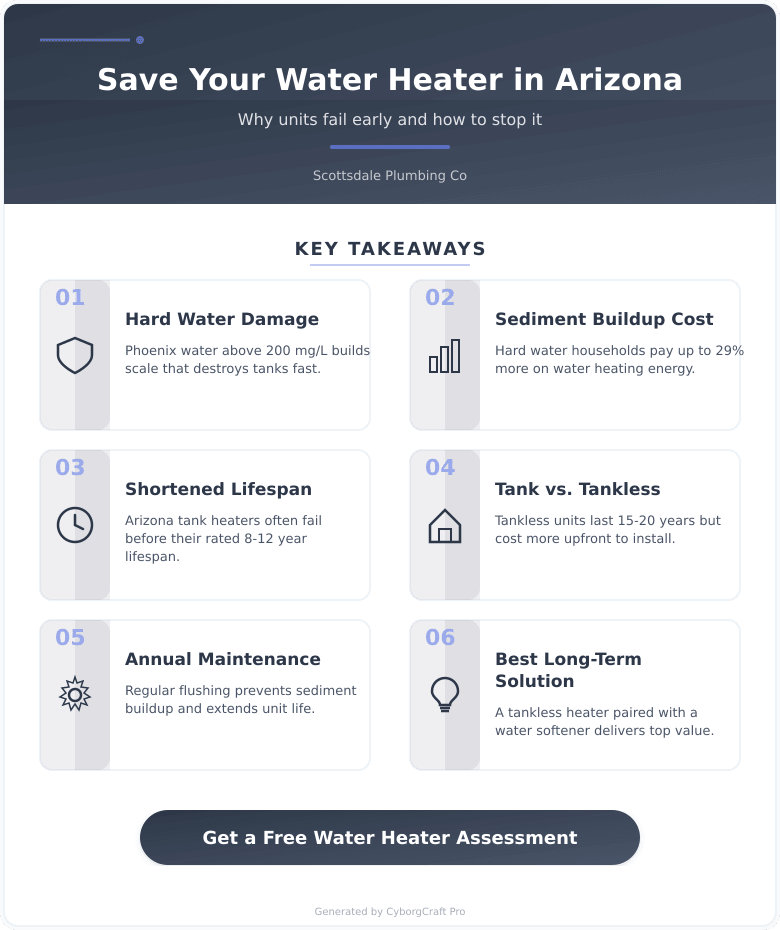
This guide focuses specifically on Arizona homeowners dealing with hard water damage, sediment buildup, and premature unit failure.
Water Heater Lifespan Definition: The expected service life of a residential water heater – typically 8-12 years for tank units and 15-20 years for tankless – measured from installation to the point where repair costs outweigh replacement value.
Most tank water heaters are rated for 8-12 years. In Arizona, units commonly fall short of that rated lifespan. That gap isn’t bad luck. It’s the predictable result of conditions specific to this state: scorching ambient temperatures, some of the hardest municipal water in the country, and a habit of skipping annual maintenance because “it’s still working fine.” The most common mistake we see is homeowners waiting for a failure before thinking about their unit at all.
What Arizona’s Hard Water Actually Does to Your Unit
Hard water (water with high dissolved mineral content, primarily calcium and magnesium) is the single biggest threat to water heater longevity in the Phoenix metro area. According to the U.S. Environmental Protection Agency, water hardness above 120 mg/L accelerates scale formation in water heating equipment. Much of Scottsdale and surrounding cities regularly measures above 200 mg/L.
Here’s what that means in practice. Minerals settle at the bottom of your tank and bake into a thick crust every time the burner fires. That crust forces the heating element or burner to work harder and longer to reach target temperature. The result? Higher energy bills, more wear on components, and a tank floor that eventually cracks or corrodes through.
Recent data from the Water Quality Association shows hard water households spend up to 29% more on water heating energy than households with softened water. That’s not a minor inconvenience – that’s a measurable, ongoing cost.
Thinking about this for your situation? Let’s talk. Contact us and we’ll walk you through your options – no pressure.
Tank vs. Tankless Water Heaters: Which Approach Works in Arizona?
Where tank water heaters succeed: Lower upfront cost ($400-$900 for the unit), simpler installation, and easier DIY maintenance access.
Where tank water heaters fail: Sediment accumulates faster in hard water, standby heat loss increases in hot Arizona garages, and lifespan drops noticeably without annual flushing.
Where tankless water heaters succeed: No standing water means no sediment tank, longer rated lifespan (15-20 years), and better energy efficiency in high-demand households.
Where tankless water heaters fail: Higher upfront cost ($1,000-$3,000+ installed), scale can still clog heat exchangers in hard water areas without a softener, and flow rate limits can disappoint larger households.
The verdict: For most Arizona homeowners, a tankless unit paired with a water softener delivers the best long-term value. If budget is the constraint now, a tank unit with consistent annual maintenance is still a solid choice – you just have to actually do the maintenance.
| Type | Unit Cost (2025) | Installed Cost (2025) | Expected Lifespan | Best For |
|---|---|---|---|---|
| Tank (Rheem Performance) | $400-$650 | $800-$1,400 | 6-10 years (AZ) | Budget-conscious, easy access |
| Tank (AO Smith Signature) | $500-$900 | $900-$1,600 | 8-12 years (AZ) | Mid-range reliability |
| Tank (Bradford White) | $600-$1,000 | $1,000-$1,800 | 10-12 years (AZ) | Pro-grade durability |
| Tankless (Rinnai RL Series) | $900-$1,500 | $1,800-$3,000 | 15-20 years | Long-term value, efficiency |
| Tankless (Navien NPE) | $1,000-$1,800 | $2,000-$3,500 | 15-20 years | High-efficiency, condensing |
Your Water Heater Maintenance Action Plan
- Step 1 – Annual Tank Flush: Connect a garden hose to the drain valve and flush sediment from the bottom of the tank. This alone can extend tank life by 2-4 years in hard water areas. Best done every 12 months.
- Step 2 – Anode Rod Inspection: The sacrificial anode rod (a magnesium or aluminum rod that corrodes in place of your tank walls) should be inspected every 2-3 years and replaced when it’s worn down to the core wire. This is the most overlooked maintenance item we see.
- Step 3 – Temperature Setting Check: Set your thermostat to 120 degrees Fahrenheit. Higher settings increase scale buildup and energy consumption without improving performance for most households.
- Step 4 – Pressure Relief Valve Test: Lift the test lever briefly each year to confirm the valve moves freely. A stuck or corroded relief valve is a safety hazard – not just a maintenance issue.
- Step 5 – Insulation Check: In Arizona garages where temperatures can exceed 110 degrees in summer, adding an insulation blanket to older tank units reduces standby heat loss and takes stress off the thermostat.
Arizona-Specific Factors That Accelerate Wear
Arizona’s climate creates a combination that’s particularly hard on water heating equipment. Ambient garage temperatures in the Phoenix metro regularly hit 120+ degrees in July and August. That means your unit’s thermostat is already fighting elevated incoming water temperatures and working in an environment that stresses seals, valves, and connections.
Compare that to neighboring states: California’s coastal installations deal with moderate ambient temperatures. Utah and Colorado homeowners face cold groundwater that demands more heating work but benefits from softer mountain water in many areas. New Mexico shares Arizona’s hard water challenge but has a milder temperature range in most metros. Arizona’s combination of both factors makes consistent maintenance more critical here than almost anywhere in the Southwest.
| State | Avg Water Hardness | Summer Ambient Temp (Garage) | Typical Tank Lifespan |
|---|---|---|---|
| Arizona | 180-250 mg/L | 100-120°F | 6-10 years |
| California (Coast) | 80-150 mg/L | 65-85°F | 10-14 years |
| Nevada | 150-200 mg/L | 95-115°F | 7-11 years |
| New Mexico | 140-200 mg/L | 85-100°F | 8-12 years |
| Utah/Colorado | 60-120 mg/L | 70-90°F | 11-15 years |
Arizona Tax Credits and Rebates Worth Knowing (2025)
If you’re replacing a unit anyway, the federal Residential Clean Energy Credit covers 30% of the cost of qualifying heat pump water heaters under the Inflation Reduction Act – up to $2,000 (2025 limits). Arizona does not currently offer a state income tax credit specifically for water heaters, but several utilities including Arizona Public Service (APS) and Salt River Project (SRP) offer rebates of $50-$400 for qualifying ENERGY STAR-certified heat pump models. Check current program availability directly with your utility provider since rebate pools can close mid-year.
See how our approach compares – explore our services to learn what maintenance and replacement options look like for your home.
Preparation Checklist Before Calling a Plumber
- ☐ Note the unit’s age (check the label on the side – manufacture date is usually in the serial number)
- ☐ Record model number and current fuel type (gas or electric)
- ☐ Measure the available space around the unit (height, width, access clearance)
- ☐ Check whether your home has a water softener already installed
- ☐ Confirm your current tank capacity (40, 50, or 75 gallons is most common)
- ☐ Note any visible rust, pooling water, or unusual sounds
Key Takeaways for Arizona Homeowners in 2025
- Hard water kills tanks early – Scottsdale and Phoenix area water hardness levels are among the highest in the country, and sediment damage is cumulative.
- Annual flushing is non-negotiable – skipping it for even two or three years accelerates corrosion significantly.
- Anode rods are cheap insurance – a $30-$60 replacement rod can add years to a tank’s life.
- Tankless units earn their cost back – in Arizona’s conditions, a tankless unit with a softener often outperforms a tank over a 15-year horizon.
- Federal rebates are available now – the 30% heat pump water heater credit is active through 2032 but utility rebate pools can close without notice.
Frequently Asked Questions
How long should a water heater last in Arizona?
In Arizona, most tank water heaters last 6-10 years due to hard water and high ambient temperatures, compared to the national average of 8-12 years. Consistent annual maintenance – especially tank flushing and anode rod replacement – can push that toward the higher end of the range.
How often should I flush my water heater in Scottsdale?
Flush your tank water heater once every 12 months in the Scottsdale area. Scottsdale’s municipal water hardness is high enough that skipping even one year allows meaningful sediment accumulation at the bottom of the tank.
What are the signs my water heater needs replacement rather than repair?
Replace rather than repair when the unit is over 10 years old, has visible tank corrosion, or requires a repair costing more than 50% of a new unit’s price. Rumbling sounds, rusty water, and pooling around the base are the most reliable indicators that replacement is the right call.
Is a tankless water heater worth it in Arizona?
Yes, a tankless water heater paired with a water softener is generally worth the higher upfront cost in Arizona. The combination eliminates sediment damage, extends lifespan to 15-20 years, and qualifies for the federal heat pump credit when you choose an eligible model.
Does Arizona have rebates for energy-efficient water heaters in 2025?
Yes – APS and SRP both offer utility rebates of $50-$400 for qualifying ENERGY STAR heat pump water heaters as of 2025, and the federal 30% tax credit applies to eligible models. Availability and amounts can change mid-year, so confirm current terms directly with your utility.
How do I verify a plumber is licensed in Arizona?
Arizona plumbers must hold a license through the Arizona Registrar of Contractors (AzROC), which you can verify at the AzROC public license lookup tool online. Always confirm the license is active and check for any disciplinary history before scheduling work.
What This Means for Scottsdale Homeowners
Most premature replacements aren’t inevitable. They’re the result of skipped maintenance, ignored early symptoms, and assumptions that a unit running today will run the same way next year. In Arizona’s conditions, that assumption is expensive.
The team at Scottsdale Plumbing Co works with homeowners throughout Scottsdale, Tempe, Mesa, Chandler, Gilbert, and Paradise Valley who want straight answers about what their equipment actually needs – not an unnecessary replacement upsell. If you’re unsure where your current unit stands, an inspection now is far cheaper than an emergency call later.
Ready to get a real assessment of your unit’s condition? Contact us today – we’ll give you honest guidance on whether maintenance, repair, or replacement makes the most sense for your home and budget.

Write a comment: