
Hidden water leak detection is the process of locating water loss occurring inside walls, under slabs, or beneath your yard that does not produce visible signs until serious structural damage has already started. Catching a hidden leak early is the difference between a repair bill in the hundreds and a foundation restoration that costs tens of thousands.
This guide focuses specifically on homeowners in Arizona who notice sudden increases in their water bills and want to identify hidden leaks before they compromise their home’s structural integrity.
Hidden Water Leak Definition: A hidden water leak is any uncontrolled water loss occurring behind walls, under slabs, or beneath landscaping that does not produce immediate visible symptoms but causes progressive structural, mold, and foundation damage over time.
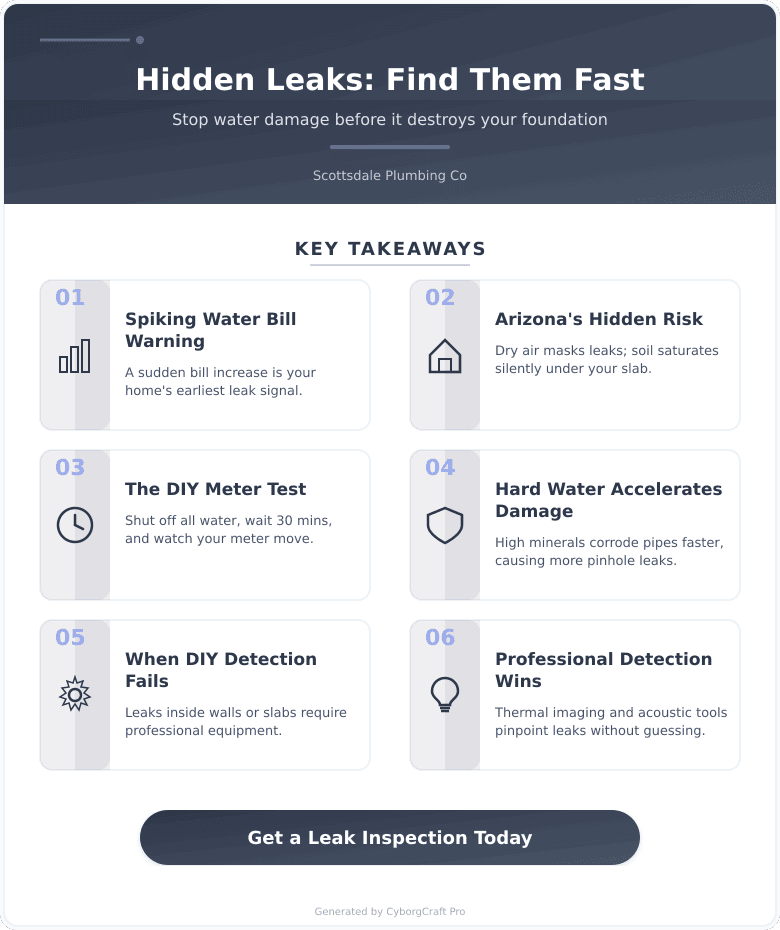
A spike on your water bill is one of the earliest signals your home sends you. The most common mistake we see Scottsdale homeowners make is assuming the bill is a metering error and doing nothing for another billing cycle. By then, moisture has often already started weakening the caliche soil layers that sit beneath many Arizona slabs.
Why Hidden Leaks Are Especially Dangerous in Arizona
Arizona’s desert climate creates a false sense of security. Because the air is dry, surface moisture evaporates fast. A slow slab leak can saturate the soil underneath your foundation for weeks before a single wet spot appears inside your home. According to the U.S. Environmental Protection Agency’s WaterSense program, household leaks waste nearly 1 trillion gallons of water nationally each year, and a single dripping pipe can waste more than 3,000 gallons annually.
Scottsdale’s hard water also accelerates pipe corrosion. High mineral content wears at copper and galvanized supply lines faster than in softer-water regions like Colorado or Oregon. The result is that pinhole leaks develop inside walls and under slabs at a higher rate than homeowners expect.
How to Confirm You Have a Hidden Leak (Not Just a High Bill)
Before calling anyone, run this quick test yourself.
- Shut off everything that uses water: Appliances, irrigation, ice makers, and all fixtures. Nothing should be running.
- Find your water meter: In Scottsdale, meters are usually near the street in a small covered box. Lift the cover carefully.
- Read the meter and wait: Write down the exact reading, then wait 30 minutes without using any water.
- Check for movement: If the dial or digital display changed, water is flowing somewhere it should not be.
- Check the leak indicator: Most modern meters include a small triangle or star-shaped indicator that spins with any flow. Even slow movement confirms an active leak.
If the meter moved, you likely have a real hidden leak, not a billing error.
Want to explore this further? Visit our services page to see how we approach leak detection in Scottsdale-area homes.
DIY Detection vs. Professional Leak Detection: Which Approach Works?
Where DIY detection succeeds: The meter test above costs nothing. Checking under sinks, around toilets, and at hose bibs for drips takes 20 minutes. You can also feel for warm spots on tile floors, which sometimes indicate a hot-water slab leak beneath.
Where DIY detection fails: You cannot locate a leak inside a wall or under a slab without equipment. Guessing and cutting into drywall or jackhammering concrete without confirmation causes unnecessary damage and does not solve the problem.
Where professional detection succeeds: Licensed plumbers use acoustic listening devices, thermal imaging cameras, and pressurized gas testing to pinpoint leaks within inches, without opening walls unnecessarily. This saves repair cost and time.
Where professional detection fails: It costs money upfront. In very rare cases, dense rebar or thick slab construction can limit acoustic accuracy, requiring multiple methods.
The verdict: Run the meter test yourself first. If you confirm a leak, stop there and call a licensed plumber for professional detection. Guessing the location is the fastest way to turn a $300 repair into a $3,000 one.
| Method | Cost Range | Accuracy | Best For |
|---|---|---|---|
| DIY Meter Test | $0 | Confirms leak exists | Initial screening |
| Acoustic Detection | Varies by provider | High for slab/supply lines | Slab leaks, buried pipes |
| Thermal Imaging | Varies by provider | High for wall/ceiling leaks | Hot-water line leaks |
| Pressure Testing | Varies by provider | Confirms line integrity | Post-repair verification |
Thinking about this for your situation? Let’s talk. Contact us and we’ll walk you through your options – no pressure.
Your Hidden Leak Action Plan
- Step 1 – Run the meter test: Shut off all water and check your meter for movement over 30 minutes. This confirms or rules out an active leak before anything else.
- Step 2 – Isolate indoor vs. outdoor: Shut off the main valve inside your home, then check the meter again. Movement means the leak is on the supply side before your main shutoff, or in your irrigation system.
- Step 3 – Check obvious indoor spots: Inspect under every sink, around toilets, near the water heater, and at washing machine connections. Fix drips you can see before escalating.
- Step 4 – Call for professional detection: If the meter confirms a leak but you find nothing visible, schedule acoustic or thermal detection. Do not delay – slab moisture damage compounds quickly in Arizona’s variable soil.
- Step 5 – Get the repair done and verify: After repair, pressure-test the line to confirm the fix held before closing any access points.
Pre-Service Preparation Checklist:
- ☐ Locate your main water shutoff valve
- ☐ Find your water meter and clear any debris from the cover
- ☐ Pull your last three water bills for comparison
- ☐ Note any warm floor spots, damp odors, or soft drywall
- ☐ Turn off irrigation controllers before any testing
What Arizona Homeowners Should Know About Permits and Repairs
Under current Arizona law (2025), most slab leak repairs require a licensed plumbing contractor and, depending on scope, a permit pulled through the City of Scottsdale’s Development Services. Re-routing supply lines inside walls almost always requires a permit and inspection. Verify that any plumber you hire holds an active Arizona Registrar of Contractors (ROC) license. You can confirm a license at roc.az.gov in minutes.
Licensing note: Arizona requires plumbing contractors to carry liability insurance and bonding. Always ask for proof before work begins.
Key Takeaways for Scottsdale Homeowners in 2025
- Act on the first spike – waiting a billing cycle lets moisture spread further under your slab
- The meter test is free – run it before spending anything
- Arizona’s hard water accelerates corrosion – older copper lines in Scottsdale homes are higher risk
- DIY has limits – locating a slab or wall leak accurately requires professional equipment
- Verify ROC license – use roc.az.gov to confirm any contractor before hiring
Frequently Asked Questions
How much does professional hidden leak detection cost in Scottsdale, AZ?
Professional leak detection costs in the Scottsdale area vary depending on the method used and the provider you choose. Acoustic detection tends to cost less than thermal imaging. Most plumbers apply the detection fee toward the repair if you proceed with their service.
Can a hidden water leak damage my foundation?
Yes – sustained moisture under an Arizona slab can erode or shift the underlying soil, causing cracks, settlement, and costly foundation repairs. Arizona’s expansive caliche soil is particularly vulnerable to water infiltration over time.
How do I know if my spike is a leak or just seasonal irrigation use?
Run the meter test with your irrigation controller fully off. If the meter still moves, the excess use is coming from your home’s supply lines, not your yard. Compare your bill month over month from the same period last year for additional context.
Does homeowners insurance cover slab leak repairs in Arizona?
Standard homeowners policies in Arizona typically cover sudden and accidental water damage but often exclude slow leaks or gradual damage. Review your policy declarations page and contact your carrier before repair work starts to understand what is and is not covered.
How long does slab leak repair take?
Most slab leak repairs in Scottsdale take one to three days depending on access and repair method. Re-routing a line through walls can take longer than direct-access spot repairs. Your plumber should provide a timeline estimate after the detection phase.
When should I call a plumber instead of investigating myself?
Call a licensed plumber immediately if your meter confirms a leak but you cannot find the source after checking all visible fixtures. Any sign of warm flooring, damp drywall, mold odor, or unexplained low water pressure also warrants professional attention without delay.
The Bottom Line for Scottsdale Homeowners
A water bill spike is not a number problem. It is your home telling you something is wrong. The homeowners who act fast – even just running the free meter test – protect their foundations, avoid mold, and keep repair costs manageable. The ones who wait often face slab repairs that run well into five figures.
Scottsdale Plumbing Co, located at 7214 E Granada Road in Scottsdale, AZ, serves homeowners throughout the Valley, including Tempe, Mesa, Chandler, Gilbert, Paradise Valley, Fountain Hills, and surrounding communities. Ready to stop guessing and get a straight answer? Contact us today – we’ll help you figure out what’s going on before it gets worse.

Write a comment: