
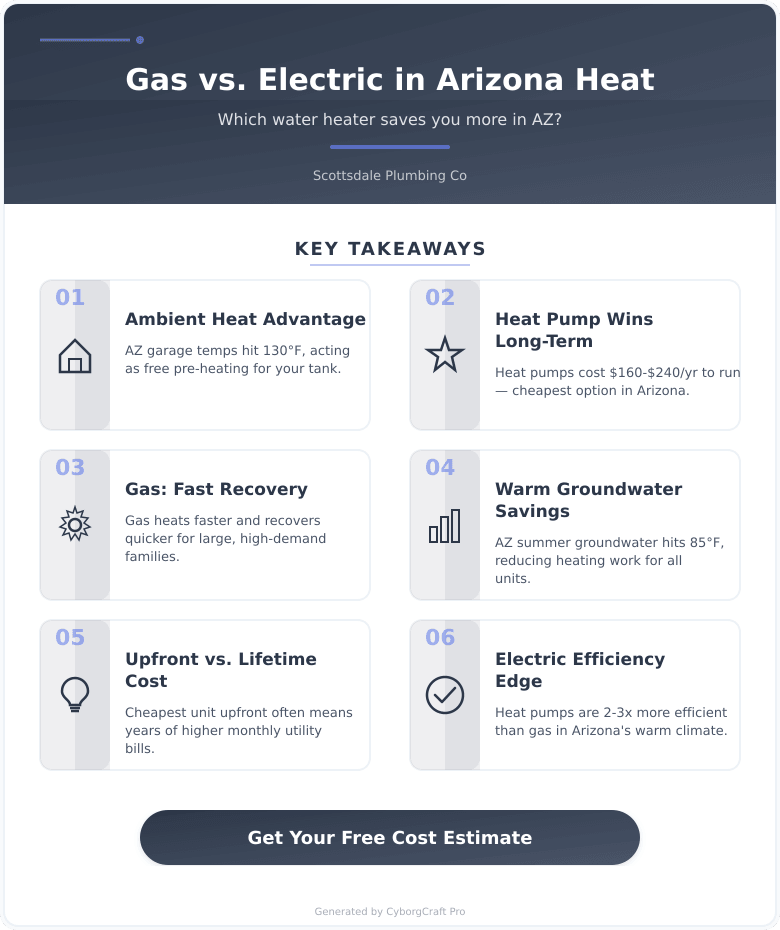
This guide focuses specifically on running costs, efficiency performance, and real-world savings for Arizona homeowners choosing between gas and electric water heating in 2025.
Gas vs. Electric Water Heater Definition: A gas water heater uses a natural gas burner to heat water stored in a tank, while an electric water heater uses one or two electric resistance elements – and in Arizona’s extreme heat, the ambient temperature surrounding both units directly affects how efficiently each one operates year-round.
The most common mistake we see Arizona homeowners make is picking a water heater based on purchase price alone, then spending years overpaying on utilities. The gap between upfront cost and lifetime running cost is wider here than in nearly any other part of the country – especially once you factor in what happens to your energy bills from May through September.
Why Arizona’s Heat Changes the Gas vs. Electric Calculation
In most of the country, water heaters work hard year-round to pull incoming cold groundwater up to your set temperature (usually 120-140 degrees F). In Arizona, summer groundwater temperatures can reach 75-85 degrees F, which means your unit is doing far less work during the hottest months. That sounds like good news – and it partly is – but the story splits depending on which fuel type you have.
Electric resistance water heaters benefit most from warm incoming water. Less temperature rise required equals fewer heating cycles equals lower bills. Gas units also benefit, but they carry a standing pilot light or electronic ignition cost that doesn’t scale down the same way.
Here’s the other factor: your garage. Most Arizona homes store water heaters in an attached garage. From June through August, garage temperatures can regularly hit 120-130 degrees F. That ambient heat acts like free pre-heating energy for your tank – reducing standby heat loss. Both systems benefit, but electric tankless and heat pump water heaters see the biggest efficiency gains from this effect.
According to the U.S. Department of Energy, heat pump water heaters (a type of electric unit) are two to three times more efficient than standard electric resistance models and perform best in climates where ambient temperatures stay above 40-90 degrees F – which describes Arizona almost perfectly.
Gas vs. Electric Water Heater in Arizona: Side-by-Side Cost Breakdown
| Factor | Gas Water Heater | Electric Resistance | Electric Heat Pump |
|---|---|---|---|
| Unit Cost (2025) | $600 – $1,200 | $400 – $900 | $1,000 – $1,800 |
| Installation Cost | $300 – $600 | $200 – $400 | $300 – $600 |
| Annual Running Cost (AZ avg) | $280 – $380 | $420 – $560 | $160 – $240 |
| Energy Factor / UEF | 0.62 – 0.70 | 0.90 – 0.95 | 2.0 – 3.5 |
| Lifespan | 8 – 12 years | 10 – 15 years | 10 – 15 years |
| Best For | Fast recovery, low gas rates | Tight budget, gas unavailable | Long-term savings, AZ climate |
Running costs based on APS and SRP average residential rates as of early 2025 and Southwest Gas average residential rates for the Phoenix metro area.
Thinking about this for your specific home setup? Contact us and we’ll walk you through the numbers without any pressure – just straight answers.
Gas vs. Electric: Where Each One Wins and Where Each Falls Short
Where gas succeeds: Gas heats water faster, recovers quicker after heavy use, and typically costs less per BTU than electricity in Arizona’s current utility environment. If your home already has a gas line and you have a large family using hot water throughout the day, gas remains competitive on a monthly basis.
Where gas fails: Gas units cost more to install if you need a new gas line. They require venting, which adds labor cost. Pilot lights and burner assemblies need more maintenance. And they don’t qualify for the same federal and state rebate programs that electric heat pump models do in 2025.
Where electric succeeds: Standard electric units are cheaper upfront and simpler to install. Electric heat pump models are dramatically more efficient in Arizona’s climate. Heat pump water heaters also qualify for a federal tax credit worth up to $600 (2025 limits) under the Inflation Reduction Act, plus APS and SRP both offer rebates ranging from $100 to $300 for qualifying heat pump installations.
Where electric fails: Standard resistance electric units cost more to run annually than gas in most Arizona scenarios. Electric heat pump units need adequate space (at least 1,000 cubic feet of surrounding air) and produce a slight cooling effect in the room – not always ideal if you’re heating a small closet but actually useful in a hot garage.
The verdict: For most Arizona homeowners in 2025, an electric heat pump water heater delivers the lowest lifetime cost when you factor in rebates, the federal tax credit, and the efficiency boost from Arizona’s warm ambient temperatures. Gas remains a strong option for large households with existing gas infrastructure and high daily hot water demand. Standard electric resistance is the weakest performer for long-term running costs in Arizona’s climate.
Arizona Tax Credits and Rebates You Should Know About
- Federal Investment Tax Credit: Up to $600 for qualifying heat pump water heaters (2025)
- APS Residential Rebate: $100 – $300 for ENERGY STAR-certified heat pump water heaters (2025)
- SRP Rebate Program: Up to $200 for qualifying electric heat pump units (2025)
- Southwest Gas offers rebates for certain gas water heaters (e.g., $550-$650 for business storage, $225 for tankless in other states), but no confirmed residential storage rebate in Arizona as of search data
- Arizona does not offer a separate state-level income tax credit for water heater upgrades as of 2025
According to ENERGY STAR, heat pump water heaters must have a Uniform Energy Factor (UEF) of 2.0 or higher to qualify for the federal tax credit. Most current Rheem ProTerra, AO Smith Voltex, and Bradford White AeroTherm models meet this threshold.
Brand Comparison: Gas and Electric Water Heaters for Arizona Homes
| Brand | Model Line | Type | UEF Rating | Price Range (2025) | Warranty |
|---|---|---|---|---|---|
| Rheem | ProTerra Hybrid | Heat Pump Electric | 3.70 | $1,100 – $1,400 | 10-year tank |
| AO Smith | Voltex Hybrid | Heat Pump Electric | 3.45 | $1,050 – $1,350 | 10-year tank |
| Bradford White | AeroTherm | Heat Pump Electric | 3.39 | $1,000 – $1,300 | 10-year tank |
| Rheem | Performance Platinum | Gas Tank | 0.70 | $700 – $1,000 | 12-year tank |
| AO Smith | Signature Select | Gas Tank | 0.67 | $650 – $950 | 12-year tank |
Your Arizona Water Heater Decision Action Plan
- Step 1 – Audit your current energy bills: Pull your last 12 months of APS, SRP, or Southwest Gas statements. Identify your average monthly utility spend and note seasonal spikes. This gives you a real baseline for comparison.
- Step 2 – Check your installation site: Measure the space around your current unit. Heat pump water heaters need adequate clearance and airflow. A hot Arizona garage is actually ideal – confirm the cubic footage meets manufacturer minimums.
- Step 3 – Check rebate eligibility: Visit your utility provider’s website to confirm current rebate availability and model requirements before purchasing a unit.
- Step 4 – Get a licensed plumber to assess your gas line or electrical panel: Switching fuel types requires either a new gas line or a dedicated 240V circuit. Get that cost factored in before deciding.
- Step 5 – Calculate your break-even point: Higher upfront cost on a heat pump unit divided by annual savings versus your current system tells you how many years until you come out ahead – typically 3-5 years in Arizona.
Ready to move forward? Contact us and we’ll help you figure out the right system for your home – no guesswork, no upselling.
What to Check Before Any Installation
- ☐ Verify contractor holds a valid Arizona Registrar of Contractors (ROC) license
- ☐ Confirm contractor carries general liability and workers’ compensation insurance
- ☐ Pull the required mechanical permit through your city’s building department
- ☐ Check that the new unit meets Arizona plumbing code (UPC as adopted by AZ)
- ☐ Confirm ENERGY STAR certification for rebate and tax credit eligibility
- ☐ Verify UEF rating of 2.0 or higher for the federal tax credit
Key Takeaways for Arizona Homeowners in 2025
- Heat pump electric units win on lifetime cost – Arizona’s warm ambient temperatures make them dramatically more efficient than anywhere else in the country.
- Gas still competes for high-demand households – Large families with high daily hot water use may still see gas as cost-competitive, especially with existing gas infrastructure.
- Rebates change the math significantly – A $600 federal credit plus up to $300 in utility rebates can close the price gap between heat pump and gas units quickly.
- Standard electric resistance is the weakest long-term choice – Higher running costs without the rebate advantage make it the least attractive option for Arizona in 2025.
- Your installation site matters – A hot garage is actually an asset for heat pump performance, which flips the conventional wisdom about these units.
Frequently Asked Questions
Is gas or electric cheaper to run for a water heater in Arizona?
In Arizona, an electric heat pump water heater is typically the cheapest to run, often cutting annual energy costs by 50-60% compared to standard electric and 30-40% compared to gas. This advantage is amplified by Arizona’s high ambient temperatures, which let heat pump units operate at peak efficiency for most of the year.
How does 115-degree summer heat affect water heater efficiency in Arizona?
Extreme summer heat actually reduces how hard your water heater works, because incoming groundwater temperatures rise significantly and the ambient air surrounding the unit is already warm. Heat pump water heaters benefit most from this effect, while gas and standard electric units see modest efficiency gains from reduced standby heat loss.
Do I need a permit to replace a water heater in Arizona?
Yes, most Arizona cities and municipalities require a mechanical permit to replace a water heater, even a like-for-like swap. Your contractor should pull this permit before starting work – if they skip it, that’s a red flag worth taking seriously.
What rebates are available for water heaters in Arizona in 2025?
APS offers $100-$300, SRP offers up to $200 for qualifying heat pump electric water heaters, and the federal tax credit covers up to $600 for ENERGY STAR units with a UEF of 2.0 or higher. These programs can meaningfully offset the higher upfront cost of a heat pump unit.
How long does a water heater installation take in Arizona?
A standard tank-for-tank swap typically takes 2-4 hours for a licensed plumber. Switching fuel types or upgrading to a heat pump unit can take 4-8 hours depending on electrical or gas line work required.
How do I verify a plumber is licensed in Arizona?
Arizona contractors must hold a valid license from the Arizona Registrar of Contractors (ROC), which you can verify free at the ROC’s public license lookup tool at azroc.gov. Always confirm the license is active and covers the scope of work before signing anything.
The Bottom Line for Scottsdale and Phoenix Area Homeowners
If you’re replacing a water heater in Scottsdale, Tempe, Mesa, Chandler, Gilbert, or anywhere else in the Phoenix metro, the gas vs. electric decision is worth doing the math on before you default to whatever you already have. The rebate programs available in 2025 are real, the efficiency advantage of heat pump technology in Arizona’s climate is real, and the difference in your monthly utility bill over a 10-year lifespan adds up fast.
At Scottsdale Plumbing Co, we work with homeowners throughout the Scottsdale, AZ area and across the East Valley to help them make this call clearly – without pushing products that pad margins at your expense. If you want an honest look at what makes sense for your home, your utility provider, and your budget, we’re ready to help.
Ready to take the next step? Contact us today for straight answers and a no-pressure conversation about the right system for your home. The summer heat isn’t going anywhere – but your energy bill doesn’t have to climb with it.
For a full overview of what we do, visit our services page and see how we approach water heater installations and replacements throughout the Valley.

Write a comment: